
Engineering Beverage Storage for a High-SKU World
Explosion of SKUs in the Beverage Industry
Imagine the wide variety of drinks down the beverage aisle at your local grocery store. Even within one brand, just think of how many flavors of Coke and Pepsi there are, including diet options and different sizes. Each of these individual product varieties is identified by its own stock keeping unit, or SKU.
Just a few decades ago, it was common for beverage companies to have less than 50 SKUs, good for high-density racking. Now, an average large beverage company might have about 500 SKUs because new product varieties are constantly released to keep up with consumer tastes.
Adel Santner is one of our sales specialists who has been working with the beverage industry for more than 30 years and has seen the industry change first-hand.
"If you have enough of a product," she said," it makes sense to go wide and deep and get as much density and product utilization as you can. But the problem is that they have diversified from 20 or 30 SKUs to 500 SKUs, which means we have to approach these distribution centers very differently."
This puts beverage warehouses in a unique spot. They can use high-density racking systems to save space; however, they also need to make sure that certain SKUs aren't buried too far behind other pallets.
Common Racking Systems in the Beverage Industry: Drive-In and Pushback
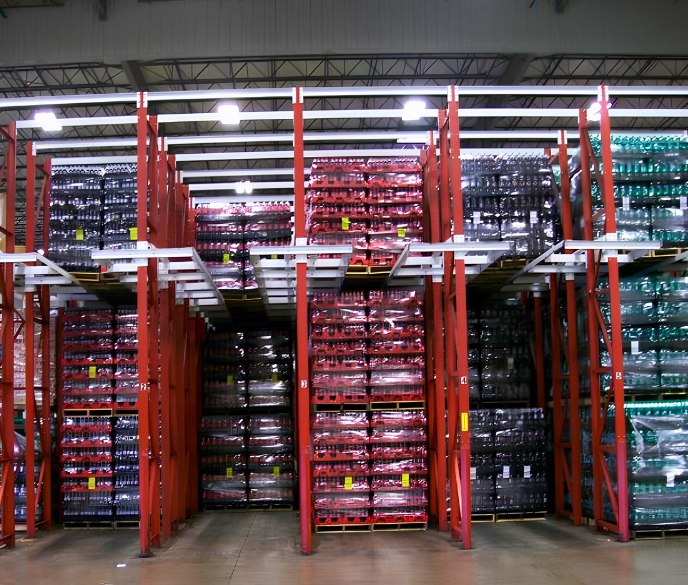
2 Wide Drive-In Racking
Drive-In racking has a forklift drive into the rack to store and retrieve pallets. It's a high-density way to store pallets back-to-back without aisles, and therefore, it's best for homogenous inventory and lower SKU varieties.
Another common variety of drive-in is a 2 Wide Drive-In rack, which is drive-in racking that stores pallets in pairs. A specialized forklift can load and unload two pallets simultaneously.
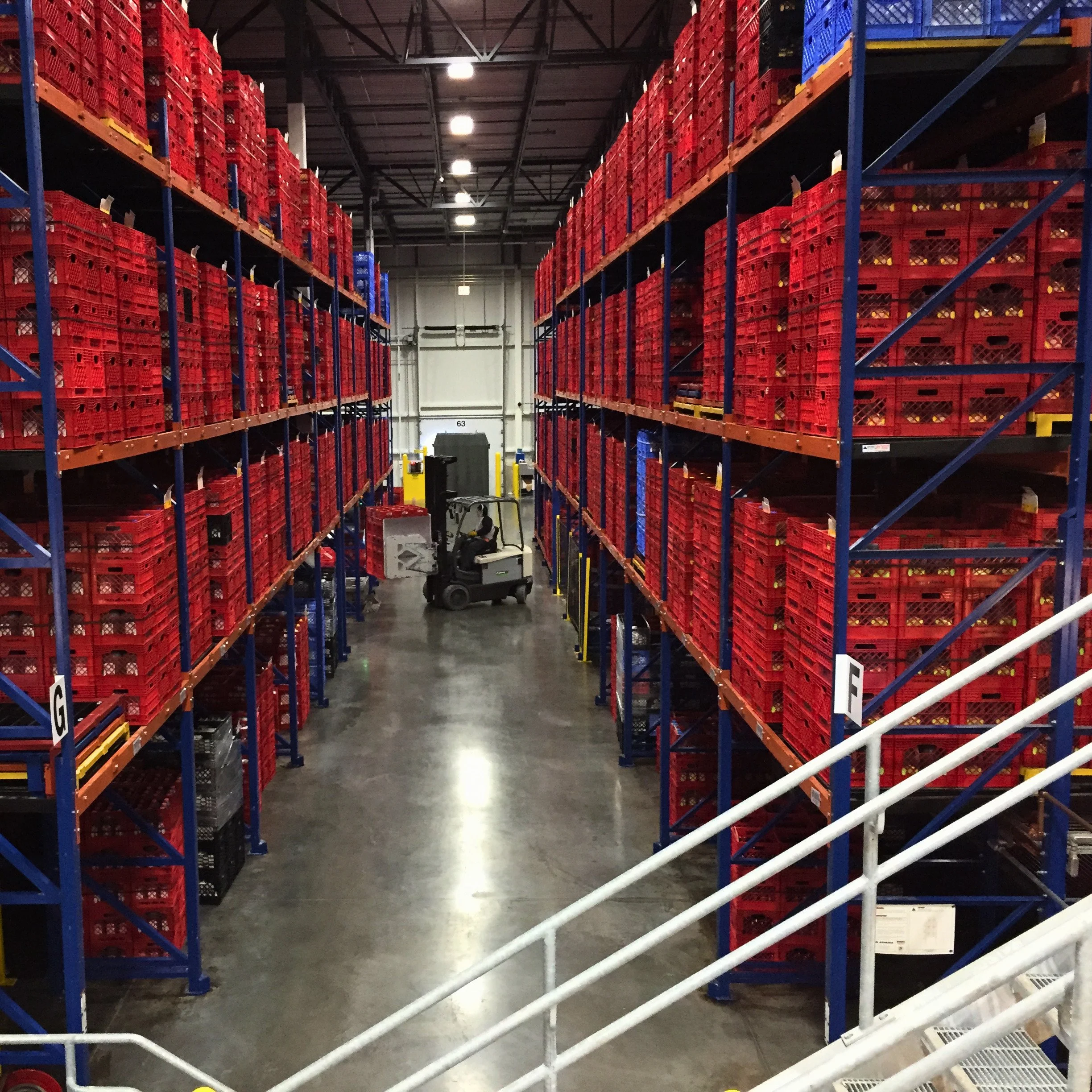
Besides drive-in, another common rack type is pushback racking. It's also high-density but has pallets on inclined rail carts. When a pallet is loaded, it pushes the previous pallet back. When a pallet is removed, gravity brings the next pallet forward. The forklift doesn't have to enter the rack, so it has much faster throughput and reduced rack damage, compared to drive-in.
Adel explained why some companies find the accessibility of pushback better suited for their SKU counts: "With drive-in, you'd have to get rid of 15 pallets to get to that 16th. That takes a lot of labor to empty it out. We went from a lot of drive-in to pushback, so it can make each level still dense, but it only has to take 5 pallets away by going to a 6-deep pushback.
"We do a lot more pushback because it gives them the flexibility of changing each level to a different SKU, versus [with drive-in], it all has to be one SKU."
Choosing the Right System
Although high-density storage is often a strong fit for beverage warehouses, selective racking remains a common choice. Beyond drive-in and pushback, other systems, such as double-deep selective and pallet flow racking, may also work well for certain beverage operations.
Each option offers its own advantages and trade-offs, and many facilities use a combination of rack types to meet their storage needs.
Curious about the ins and outs of beverage supply chain?
We can help find the best storage system that fits the unique needs of every project.