
Labor pressures, real estate costs, and increasing throughput demands are all pushing warehouses to find ways to do more within the space they already have. Automation is increasingly becoming an answer to this problem.
Warehouse automation encompasses basic machines that perform repetitive tasks, software tools, and the integration of artificial intelligence systems. Pallet-based forms of automation include machinery like cranes, vertical lifts, and pallet shuttles that help move inventory automatically.
Why Choose Automation?
Jesse Swanson is an Advance sales specialist who works closely with automation, and he offered some insights into who chooses automation, and why.
"There are certainly a lot of greenfield projects that are designed around automation, but probably, a much larger percentage of them are what we call brownfield projects, where a company wants to improve their operations, whether that's density, the ability to have higher throughput of materials, or a better picking operation within the four walls they already own.”
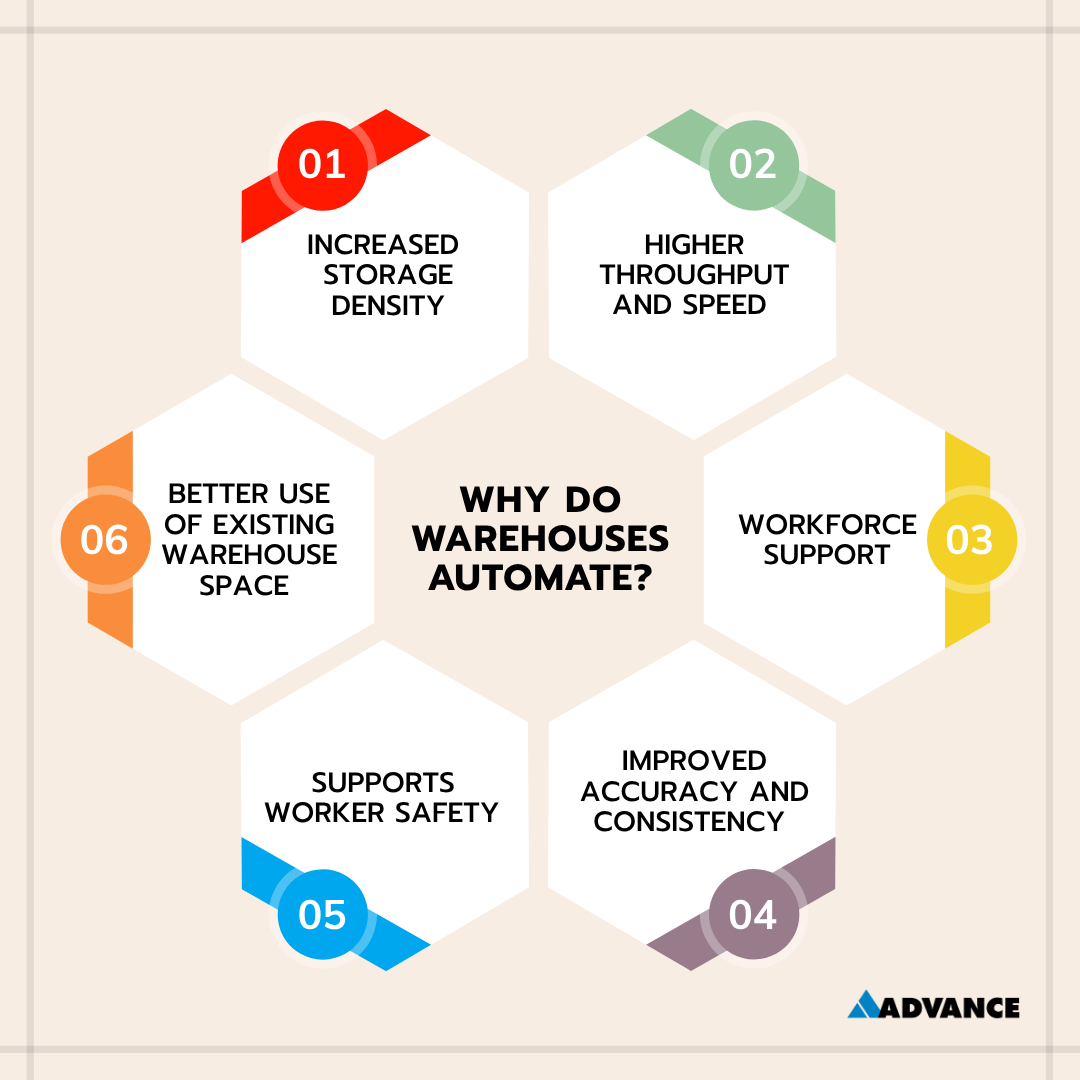
Why do warehouses automate?
Increased storage density
Higher throughput and speed
Workforce support
Improved accuracy and consistency
Supports worker safety
Better use of existing warehouse space
What Industries Most Benefit from Automation?
Automation works well in a wide variety of industries that need:
High-density storage
Good selectivity, often because they have a variety of inventory or SKUs
Fast throughput and inventory movement
For example, food and beverage industries are often well-suited for pallet shuttles as a way to make use of valuable space, including in temperature-controlled environments.
"You'll see a lot of drive-in racks in food processors or agricultural settings," Jesse said. "A lot of great agricultural growers use drive-in, and many of them are switching to semi-automation. You have certain grades of apples, for example, that you need to keep segregated. So, it's becoming slowly but surely more widespread."
Increasing throughput is another major draw to automation since it supports how fast inventory is brought in, stored, broken down, and eventually shipped out. While all storage industries could benefit from better throughput, fast-moving facilities like e-commerce, retail, and 3PLs can be especially drawn to automation for this reason.
How Do Racks Support Automation?
Pallet racking includes structural and roll form racking. Structural racking is welded and therefore exceptionally durable. It can better withstand impacts from forklifts and support heavier loads. Roll form, on the other hand, has bolted connections and is easier to configure. Both can be used for automation, but roll form has some unique benefits.
Benefits of integrating roll form with automation:
Configurability
Pre-punched uprights that allow for greater precision for automation.
More component options like gauges, widths, and column shapes allow for easier customization and integration
Rack Protection
Automation reduces forklifts operating in the rack system, so the risk of collision damage is reduced
Upfront Costs
Roll form systems can cost 10% to 30% less than structural rack, depending on the application
Structural racks can also be well-suited for automation integration in cases when it has the right precision for automation or when additional durability is needed, such as with rack supported structures. With hybrid systems, for example, structural components add better durability to the base of a roll form rack to add capacity and protection from forklift damage.
How Do Pallet Shuttles Compare to Traditional Racking?
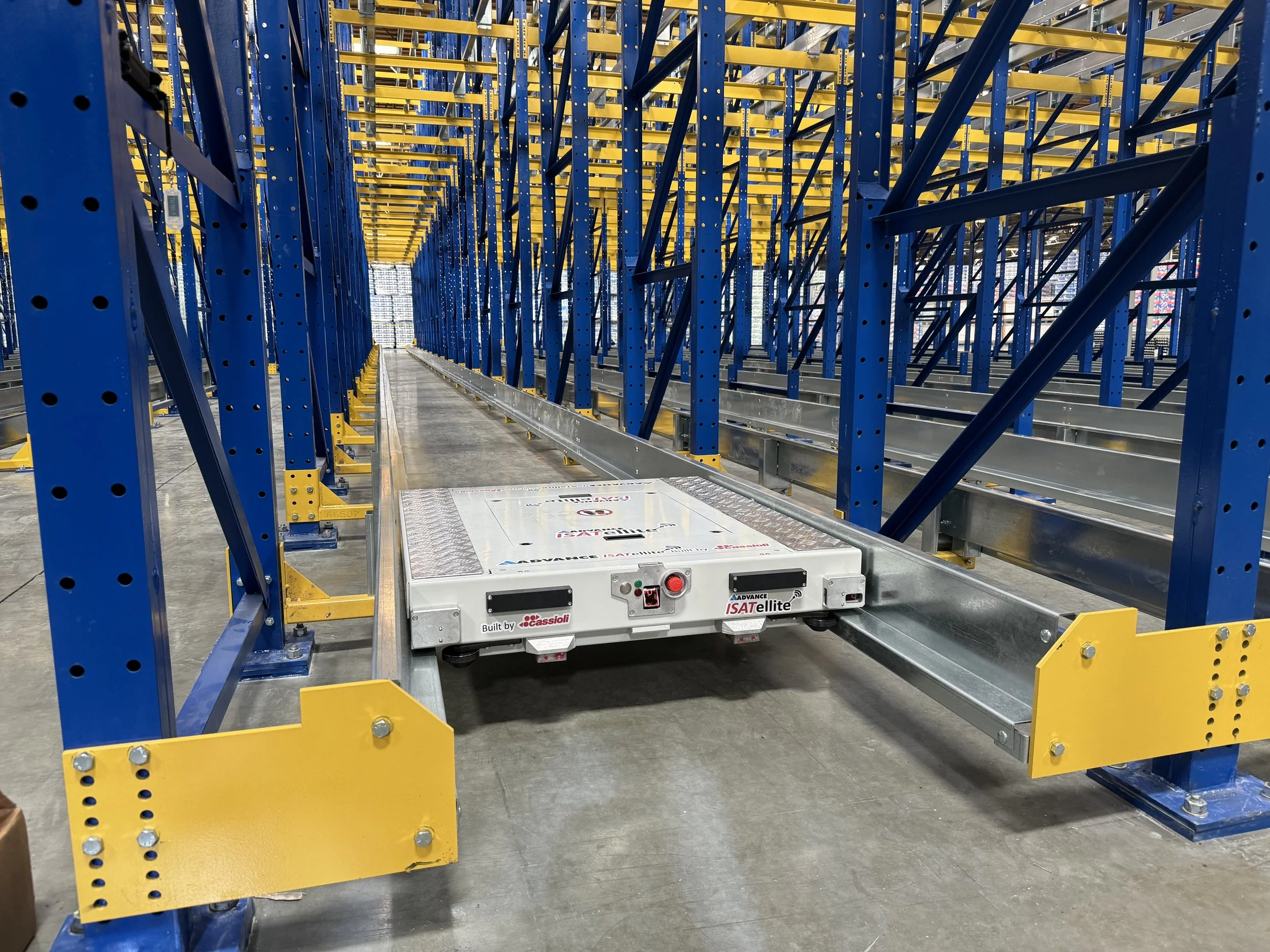
Pallet shuttles, like the semi-automated ISATellite shuttle, are a form of automation that offers high-density storage by moving pallets within the rack for easy forklift pickup.
But there are plenty of racks that are already high-density, without automation. What's the difference?
"With pallet shuttles, you get the benefit of a very dense, deep lane storage, similar to drive-in," Jesse said, "but you have much more selectivity to it. And so, it allows better rotation of inventory and better use of space because you can store more varieties of products in the same footprint."
Drive-in rack is a very high-density system where pallets are stored back-to-back without aisles. However, a big downside is that to access pallets towards the back of the rack, all the other pallets would have to be removed so that the lift truck can drive into the rack to reach them.
Pallet shuttles also offer deep high density; except they have one shuttle per lane. To access a pallet in the back, only one lane would need to be removed, instead of the entire rack.
Pushback is another high-density racking system that can access pallets per lane like this, but it is typically 3-6 pallets deep, unlike pallet shuttles that can be up to 30 pallets deep.
Pallet shuttles have the deep density of drive-in, but the selectivity of pushback. That's why they're worth the investment for operations that need both benefits.
Automation As Part of Future Growth
Racking is just one piece of a larger warehouse ecosystem, which is increasingly including automation. Even an operation who thinks they're too small for automation may consider how the other parts of their ecosystem support future growth, which is one of the many needs we consider when engineering the right storage solution for an operation.